ゴジラ Godzilla (1954)
| Published | |
| Reading time | 20 minutes |
| Licence |  |
| Tags | Movie - Showa - Godzilla - Tokyo - Proofread by an LLM |
Trigger Warning
I discuss death, war, and atomic mass murders.
The article is light, but at times I’m very serious!

Hello folks. Today I’m going to talk about Godzilla, the very first film. It was released in 1954 in Japan, so yeah it’s not very recent. Yet everything is there. Everything we know about Godzilla is there.
I’m not going to summarize the film or tell you the story. For that I invite you to go read wikizilla or wikipedia.
No, here I’m mainly going to show you some parts to convince you that yes it’s a good film, and yes (also) everything that is iconic in modern Godzillas was there from the beginning! These people were visionaries 😛
Worth watching or not?
I already said it in the intro, but this film is a masterpiece. It’s absolutely worth watching. Place your Michael Bay expectations in the closet for the duration of the movie because even though the film has aged well in many aspects, it remains rather slow and has that characteristic rhythm of ’50s-’60s films. Think of it as 2001: A Space Odyssey, grin and bear it, listen (or read) the dialogues carefully, and put your phone in the closet with Michael Bay.
WATCH this film, it’s absolutely brilliant, especially if you’ve already seen other more modern Godzillas, like Godzilla Minus One from 2023, you’re going to love it.
I’m obviously going to spoil parts here, but rest assured I’m going to carefully hide some interesting bits for you to discover yourself.
And besides, spoilers never ruin a good film (fr) 😉
First roars ever, and in music
Heavy, saturated footsteps announce what we know is coming. Something big, scary, terrifying.
Then the film opens with the iconic, the unique, the very special Godzilla’s Roar. A sound that characterizes him and that will follow him throughout his career. Well I think, I haven’t checked yet, but I’m starting.
The equally iconic and majestic music that we all know (yes yes, you too) comes to dress these sounds as unpleasant as they are enjoyable. Composed by 伊福部 昭 Ifukube Akira he will create what will be both a musical icon and an inspiration for so many filmmakers (Spielberg included).
Personally, this beginning gives me goosebumps since I saw all the (more) recent films. It’s like reverse fan service, returning to the source. A pleasure that’s just beginning.
I’m not going to translate videos, so speech and displayed text will remain in the original versions. It’s not necessary to translate to understand my point normally.
Here, the texts are “only” the names of people involved in the film, it’s the opening credits. They were at the beginning back then, which means the film ends very abruptly without the traditional (for our era) end credits.
A Kaiju film, no THE Kaiju film
This film is often considered as having defined the Kaiju film style in which we basically find:
- The use of miniatures sets for scale effects
- People in monster suits
- Quirky monsters, with… particular faces I would say.
- Often the monsters are huge, hence the necessary scale effects
This film from 1954, contains its share of particularly striking scenes that have aged really well. Well, I say that, but you have to look past the fact that the film is in black & white, and that yes we can see very well that these are miniatures diorama. However, the result remains coherent, and today makes you smile, but doesn’t make the film any less impactful.
Right from the start we have a little scene that reminds us of all this, a simple boat sinking. I find the fire effects particularly convincing. It’s only the subtle movements on the water that betray its real scale.
And a bit later, there’s a storm scene that batters actors, not very good actors. Well, in fact yes, they’re very good. It’s just that the expectations of the era were not the same as today. What I find overacted was the norm before. In any case, it’s fun to watch, and it’s a good way to calibrate my expectations for the rest of the film. Rather than watching it with disdain, I’m going to watch it with wonder, appreciating all overacting at its true value. Sometimes, it’s true, while laughing heartily. That’s part of the experience now.
Clearly, the construction and lighting work is simply striking. Yes we’re not fooled by the scale effects because the cameras of the era didn’t allow what we can today, but dam it’s impressive. Personally, I feel all the love of the model makers and miniaturists in these shots. And it will be like that throughout the film(s).
But where is the monster?
The film takes its time; really. Built around 3 acts, the first takes a good big third of the film. We’re told about folklore, stories of old fishermen who tell that once a monster had been spotted when fish were scarce. Its name? Gojira (Godzilla).
And there you have it, the name of this prehistoric dinosaur is sealed forever. In the film it’s this story that serves as justification to name the monster when journalists need a big title for their special edition.
However, still no monster on screen. There has been destruction, noises, but nothing visual of Godzilla himself. First clue and first characteristic of this invisible monster forged, forever: a huge footprint right in the middle of a village. A radioactive footprint! Our monster is RADIOACTIVE.
So there we learn that the thing is big. Look at the size of the footprint. Also, the thing is radioactive!! The Geiger counter goes crazy, we can hear it well.
Godzilla is therefore:
- Big / Tall
- Radioactive
A few minutes later, we see trilobites hanging around. TRILOBITES, the thing supposed to be extinct for hundreds of millions of years. Godzilla therefore brought things from his home, old things. Nothing suggests it’s voluntary on his part, but more that these creatures accompany him as parasites (symbiotic?). He dropped a few on his path.
Godzilla is therefore:
- Old (or at least hangs out with things from 250 million years ago)
And now the drama. A villager sounds the general alarm and all these people who were quietly taking measurements and collecting samples rush to offer a quite striking shot-reverse-shot.
No, actually it’s mostly very funny today 😁. I can very well imagine the actors placing themselves on their mark, with the director insisting: “Imagine that this camera reveals itself to you, roars, is dozens of meters high, is terrifying!!”. Basically, the beginnings of green screen acting,… without green screen.
Godzilla is finally revealed. His size finally comparable to the rest of the world. A flawless composite shot, which even today renders very well.
So admire this person in a suit playing the big monster, in front of a (small) terrified crowd. A childhood dream!
I can’t help but consider the parade of scientists, reporters, and other explorers facing the camera as having a comic effect. Same for the “terror” on each face. But sorry, let’s put this film in its era, it’s terribly well acted!
The revelation at the end with the tracks on the beach… Marvelous!
So yeah, it’s well done, but it’s sparse for now. Almost all is suggestion. It looks like Spielberg (or is it Spielberg who looks like Honda Ishirō? 😏)
The suit
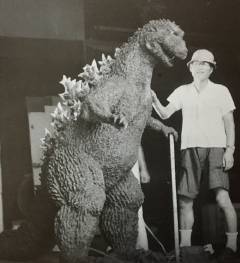
Before going further, a little word about the suit.
The ShodaiGoji (初代ゴジ).
I’m not going to paraphrase all the articles and wikis that talk about it, but some interesting info must still be kept in mind, especially when we watch the next excerpts.
The suit is a rubber thing on a wooden and metal frame (if I understood correctly), with cotton and fabric inside for a soft effect (no, that’s wrong, it was just so the thing wasn’t just a cutting blade for the actor).
Anyway, the important point is that this thing is far from a simple pajama. The damn thing weighed nearly 100Kg. Imagine yourself in there, while there are iron bars everywhere, that you have to “play the monster” and roll around with it!
Lucky them, all the parts that move on the head are operated elsewhere, it’s someone else who does it. But still, they had to carry the thing around and destroy everything “properly” as the director wanted. No second take, otherwise you have to redo all the miniatures.
Revelations
Well, the old fishermen were right. We knew, we saw the title of the video the film. But the film’s characters had to
see it with their own-eyes! (yeah it’s one word for me, “own-yeyes”. It’s our critical eye you see)
Since I’ve already seen quite a few Godzilla films, I notice another recurring motif settling in nicely. Yeah, I didn’t see all the films in order huh, I started with the more recent ones before growing into a better version of myself, one who can grin and bear it.
So, what was I saying? Oh yes, since I’ve already seen quite a few Godzilla films I notice a rather déjà-vu scene. The PowerPoint™ of the era with acetates, like back then (yeah I’m old, there were no “interactive” boards when I was in middle/high school).
This scene, save it somewhere in you mind, it’s going to become classic in the franchise. Personally, I find it like a running gag, but right now it’s serious. It’s the first film, and it’s not joking around.
It’s the catch-up session for all those who were looking at their phone during the entire first part. I told you to put it away, you’re lucky the teacher is doing a catch-up lesson!
We don’t learn much, but everything is recapped. Basically:
Godzilla is:
- Big / Tall
- Radioactive
- Old or hangs out with old things
We even get a mugshot of Godzilla at the end.
Ah yes, I almost forgot, we do learn something new though. The film’s characters make a conjecture about the reason for Godzilla’s coming or awakening. Because yes, the old fishermen speak of an old legend (even for them). So why is he coming back now?
This is where we arrive at the fundamental of what Godzilla represents. At least in this film. Because I find it changes a bit in the following ones.
Godzilla came back because we messed up the seabed, where he lived/hibernated (strike out your least favorite). Moreover we didn’t hold back ! We atomized the thing. Like A-Bomb, H-Bomb, etc…
We all know how annoying it is when the FBI or the GIGN drop by to “politely” smash your door under an atomically overpowered search warrant. So it’s kind of expected for poor Godzilla to be angry and comes to mess up our home. The flowerbeds are unlikely to make it.
It’s suggested that the bigness of Godzilla and his superpowers (we’ll see later) comes from radiation induced by our nuclear tests.
Godzilla is homeless. We most likely exterminated his whole family, and now he’s coming for us.
More seriously, Godzilla represents the consequences of using atomic weapons. This film comes barely more than 10 years after the mass murder of civilians perpetrated by the USA on Hiroshima and Nagasaki.
Even though Japan is in full imperial colonization by the USA, this film talks about the consequences of weapons as powerful as atomic bombs. Godzilla himself will be a destroyer, and whether he has agency or not doesn’t change the basic point: Lots of people died. If Godzilla himself is a sentient and thinking being, his will can then easily be a metaphor the USA will itself as a war nation. A kind of revenge for having destroyed his home (Pearl Harbor?). If American imperialism on Japan is at work in this film, it’s probably in this little bit of lore. A kind of “good” reason to destroy everything. We’ll see later with… the sequels, but this angle of analysis really seems to survive well and strengthen from episode to episode.
Okay, let’s get back to a lighter level, to laugh a bit more with this film.
Destruction scene
Now that our friend, with a regrettably short family tree, is clear to everyone, even to the film’s characters, he’s finally going to come and wreck everything. The poor humans will try to bring out the big guns. A classic here too, where almost all of Japan is put to contribution, a bit like Evangelion. (or is it Evangelion that’s like Godzilla 😏).
We try to electrocute this big lizard with everything we have. The effects are classic for the era, I suppose the film was simply painted to make the sparks effects. We can see how a person can hide in this monster. But it makes him even more touching, when he himself pass though the high voltage lines as if it were a simple spider web.
Note that this suit which already weighs 100kg had to be operated in water! I can’t even imagine the physical endurance needed for that.
Well, all the cannons unleash on Godzilla, while he breaks the Lego towers made by little brother without even realizing that all the artillery is pounding him.
I don’t know how the model makers take the destruction of their works. Are they happy? Sad? Both? Something else? In any case it renders well. It bends as it should, well almost. The smoke everywhere makes it all even more convincing, but completely breaks the perspective and scale effects.
Then, we discover for the first time in IMAX 4D Dolby Atmos, without smell-o-rama, Godzilla’s fetid breath that melts everything. The heat ray that kills.
Note that we see our friend up close, and how hideous he is! Honestly he’s so ugly it’s beautiful.
Well, that’s not all, but he still has plenty of things to destroy, and past human defenses, it’s the city of Tokyo that’s going to take a beating.

Visually, it’s magnificent. The burning buildings are really believable. Too bad for Godzilla who does a camera look that must have been forgot during editing. They could have done another take honestly.
Also, very striking this Hotwheels™ accident 😁. It contrasts quite a bit with explosions worthy of 80s films. I won’t mention the time-lapses, which are really a classic for the era; besides rather subtle here.
The end with that foot, no, that Godzilla thigh that fills the whole frame; Magnificent! To finally demonstrate all of the man in the suit skill to destroy this warehouse by showing only a small piece of this thigh, no of this foot; Magnificent!
And note the quality of Godzilla’s composite when the villagers flee in terror! Great (technical) art!
A small excerpt where Godzilla positions himself politically and shouts ACAB in his way!
I’m showing you this excerpt because what’s obviously interesting here is the compositing of people in buildings, and at the end of the excerpt when we see him in the background of the city. A city that burns in its entirety. Observed by villagers composited at the bottom. A powerful final result.
Another motif, or rather should I say another setup, journalists on rooftops doing their job. They describe, they film, they record. Nothing will stop them from doing their job, until the last moment, not even this big arms T-rex. Well, in this particular film, they’re a bit cowardly, and stayed well away to not smell Godzilla’s bad breath.
Let’s note that Godzilla seems to dislike clocks. No explanation is ever provided regarding this visceral hatred. It’s a totally free interpretation for the viewer. Poor clock…
Humans may be small, but they have small planes and that’s another setup here. Godzilla versus planes. Here, sorry I’m going to spoil the surprise, the planes, they don’t win.
The music is also really perfect for this moment. A treat! It almost looks like a Michael Jackson video at the beginning. Almost as if we’d expect Godzilla to start dancing like a zombie. But no, he just lets the big kids play with planes for a few minutes before remembering that Parent 2 said “dinner time” 10 minutes ago already and goes into Tokyo Bay to go eat.
If you have an eye. Or especially just if you finally put your smartphone in the closet like I told you, you’ll spot the sophisticated rocket guidance techniques. The missiles, not the salad huh. Probably something very technological based on c12h22n2O2.
The consequences

Well, here we’re going to get serious again for a few moments.
The film takes a very sinister turn, even in our times. Because if today we don’t perceive the terror and catastrophe through the images, as it could have been the case at the time when we weren’t used to ultra-realistic 3D effects, we fall back very quickly on our good old reality. Having visited the Hiroshima Peace Memorial Museum, and therefore seen some photos and, even more horrible, some drawings and accounts of the consequences of this mass murder of civilians by the USA on August 6, 1945 at 8:16 AM, I can say that this part of the film is rather chilling. It’s a film, and era requires, the images are very “clean”, but suggest largely what’s needed, and don’t spare difficult images.
The representation of Tokyo after Godzilla’s passage resembles in every way Hiroshima a few hours after the explosion. At least, from what has reached us.

The improvised hospital recalls the (numerous) history of these places that served as refuges, and post-apocalypse help centers. Personally, I think back to this school which had “survived” thanks to its reinforced concrete construction technique despite its proximity to the bomb’s detonation point. The film scene plunges me back into it, mainly because the structure and walls are alike. Surely this architecture is widespread in Japan, but here I can’t help but make the connection with the staircase where survivors wrote the names of those they were looking for.
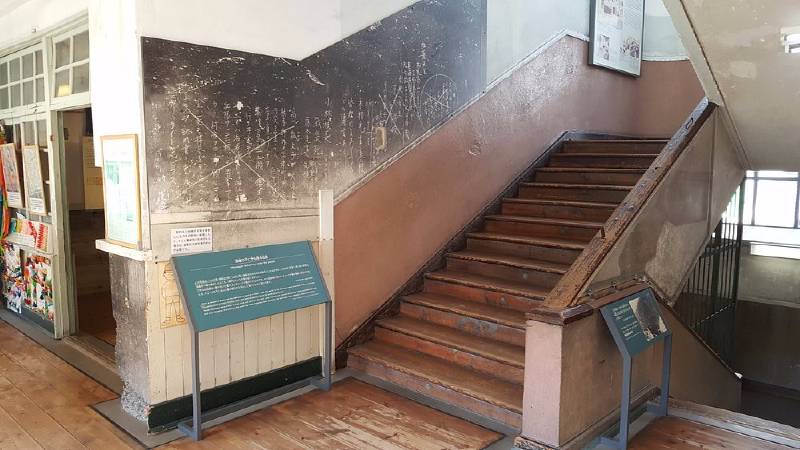
The film makes its point again, in case the viewer had forgotten;
Or I had forgotten;
Or you had forgotten;
Or we had collectively forgotten.
These schoolchildren singing… I don’t have the translation of their songs, the film’s subtitles did not provide them. But it moves me a lot, it’s strong.
I’m not talking about everything to keep part of the film for you to discover, but this second disaster exposition is far from trivial, and fully serves the narrative’s purpose. It advances the story in a… Well, watch the film (or read the complete summary) if you want to know. I don’t want to cover everything here.
Small aside concerning the shot of the image in the TV. It’s another recurring motif in Godzilla films. For me, the images of destruction are put inside another screen, as if they themselves were fiction. A double level of fiction, so that the characters can still (a bit) deny the reality of this desolation, but it’s no longer possible.
The end
Without revealing how, humans, more exactly Japanese humans, end up winning against Godzilla.
Note that Godzilla walks on the ocean floor. He doesn’t float. At least not here.
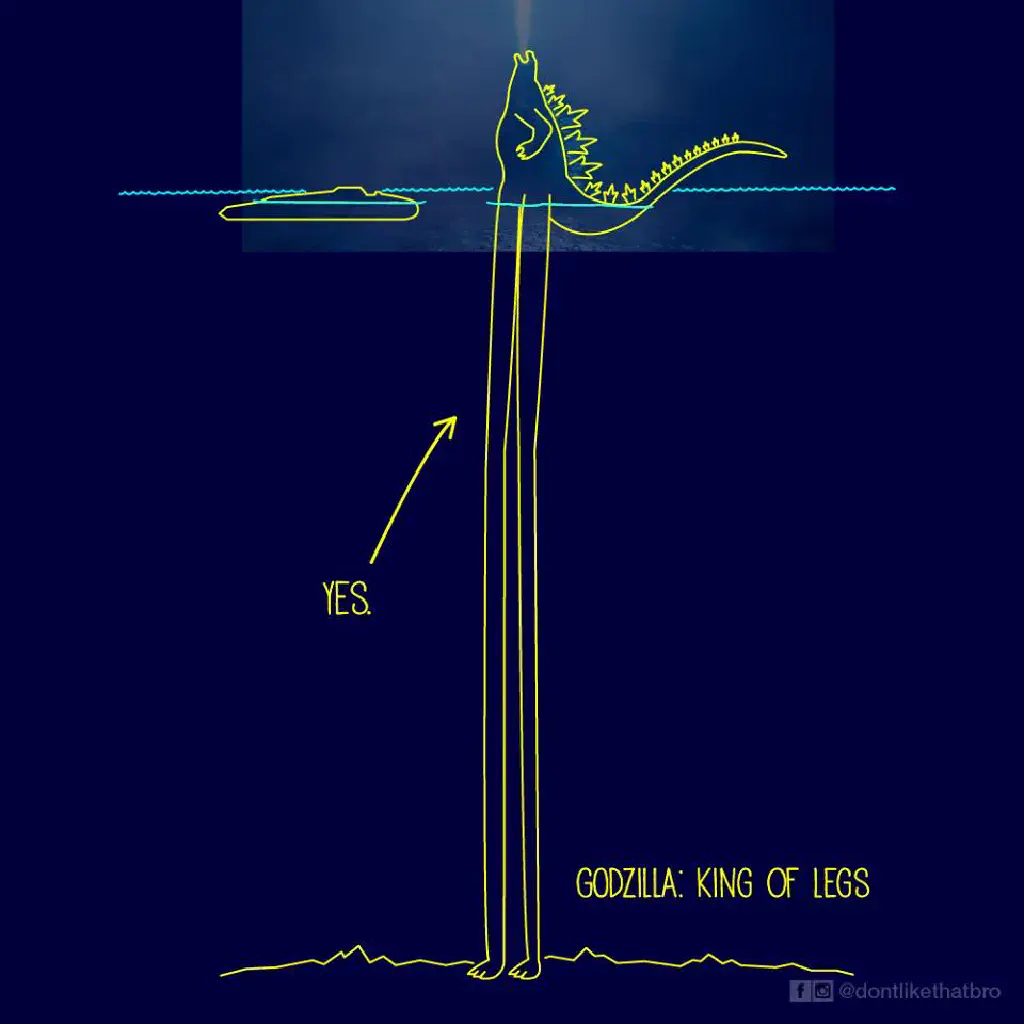
The film ends on a boat taking a beating, with a Godzilla dying like a 5-year-old child would make it in their bathtub. At least, at the beginning. After it’s more of a paleontologist’s fantasy.
Note that Godzilla’s death is beyond any doubts. He is defeated, destroyed, literally dissolved in the water. Quick, direct and painful according to the official translators of his roars.
There you go, spoiling is done. He dies at the end. This obviously didn’t prevent the making of dozens of canonical sequels, so don’t feel like you hold all knowledge and power in your hands. There’s still much to discover.
Final thoughts
Well, this film is a masterpiece. The first person who says I’m exaggerating is just not worthy of receiving all this entertainment, and should go back to playing marbles or Pogs.
It bears the mark of its era. It’s unintentionally fun, yet it never tips over into camp. On the other hand, it’s completely outdated, but we forgive it, it’s the era we said.
The film’s purpose is interesting, full of hope (Godzilla is defeated) and sadness (the consequences, and the means used to defeat him). Since I haven’t said everything, you’ll have to dig on your own to understand what I mean by that. Because my goal here is twofold. First to make you live the film like me, or at least a part of it. To share my excitement, my disappointments (there aren’t any here), my sadness, and my reflections and analysis. So that the crazy idea of watching ALL Godzillas goes from a… crazy idea precisely to a revelation of evidence to you (We all have the right to dream). All this for my second objective, to convert you. For you to become a Godzilla fan. But not just a fan of his entertaining aspect, of his destructions, of the chaos he creates (yes all that is super cool), but also of what he represents. Of what Godzilla shows, through the eras. Because remember that Godzilla films have been made and plenty since this one in 1954!!!.
This first opus lays the foundations. We see it, everything is there and will be taken up, remixed, reinvented, copied, plagiarized, innovated. I had to take the time for this film. It’s quite likely that I’ll be much more succinct on the dozens of others. Otherwise it’s going to take me a lifetime to write these articles, hoping I keep up the pace 😅.
See you soon for the next one. I’ve already seen it, just need to clip and write the article.
Thanks for reading me,
Bisoux 😗



| Title | ゴジラ Godzilla (1954) | |
| Description | Excerpts, analysis and sharing of feelings after watching the 1954 Godzilla film. Why this film is a masterpiece! | |
| Published | ||
| Updated | ||
| Type | ||
| Reading time | 20 minutes | |
| Words | 4068 | |
| Translation | English | https://blog.ztec.fr/en/godzilla/1954-godzilla/ |
| Français | https://blog.ztec.fr/godzilla/1954-godzilla/ | |
| Tags | Movie - Showa - Godzilla - Tokyo - Proofread by an LLM | |
| Licence | Except for quoted materials, which retain their original rights and attributions, this post and its content are published under the Creative Commons(CC BY-NC-SA 4.0) liscence | |
| OpenGraph | Image |  |
| Title | ゴジラ Godzilla (1954) | |
| Description | Excerpts, analysis and sharing of feelings after watching the 1954 Godzilla film. Why this film is a masterpiece! | |
| Type | og:type = article twitter:card = summary_large_image | |

Found a typo, or something bigger that probably killed a grammar nazy ? suggest a fix via github.
You can subscribe via
 RSS to get new articles as son as they are published